
WMS v/s ERP in Logistics: What’s the Difference?
Logistics in the digital age is fast-moving, and efficiency is important. Businesses are under constant pressure to deliver faster, reduce costs and maintain accuracy across supply chains.
Here is where Warehouse Management System or WMS and Enterprise Resource Planning ERP play a key role.
Many businesses struggle to understand the difference between WMS and ERP, assuming they serve the same purpose.
This can lead to poor investment decisions, operational inefficiencies and missed growth opportunities.
What is WMS in Logistics?
WMS is state-of-the-art software that is developed to manage and optimize warehouse operations. It focuses on real-time inventory, tracking, picking, packing, shipping and receiving processes.
This innovative software ensures that every product is stored, tracked and moved efficiently within the warehouse, reducing errors and improving productivity.
What is ERP in Supply Chain?
ERP integrates multiple functions such as finance, procurement, human resources and supply chain operations into a single platform.
ERP functions provide a high-level overview of operations, helping businesses manage resources, plan demand and maintain financial control.
WMS v/s ERP Systems- Key Differences
- Functionality: WMS focuses on warehouse-level operations like managing inventory and order fulfillment. ERP manages overall business processes across departments.
- Details Offered: WMS offers granular, real-time data about inventory location and movement. ERP provides strategic-level and summarized data for making decisions.
- Real-Time Tracking: WMS is built for real-time updates within the warehouse. ERP may not always provide the same level of immediate visibility.
- Customization: WMS caters to every need of the warehouse, while ERP is generalized and requires customization for logistics-specific tasks.
- Integration: Modern businesses integrate WMS with ERP to blend operational efficiency with strategic planning.
Role of WMS in Warehouse Operations
- Real-Time Inventory Checking: WMS provides accurate and real-time tracking of inventory across the warehouse. Such tracking ensures businesses always know stock levels, locations and movement, reducing stockouts and overstock situations.
- Efficient Receiving Process: The goods are understood by the WMS system, received by verifying shipments, updating inventory instantly and assigning optimal storage locations. This reduces delays and improves accuracy from the start.
- Optimized Storage Management: WMS uses smart algorithms to suggest the best storage locations according to the type of product, demand and availability of space. This maximizes warehouse space utilization.
- Faster Picking and Packing: WMS improves order fulfillment by guiding workers through the most efficient picking routes. This reduces time, errors and increases productivity.
- Reduce Errors: Bar code scanners and automation reduce manual errors. Thus, inventory is handled with utmost precision, ensuring higher accuracy in the operations.
- Improved Labour Productivity: WMS help the warehouse manager to assign tasks efficiently, track employees’ performance and reduce idle time. This leads to better workforce utilization and cost savings.
- Increased Order Accuracy: WMS ensures the right products are picked, packed and shipped, improving customer satisfaction and reducing returns.
- Optimum Space Utilization: With optimized storage strategies, WMS helps make the maximum use of space available in the warehouse. This reduces the need for expansion.
- Seamless Shipping Process: By integrating shipping systems to automate label generation, documentation and dispatch processes, WMS ensures timely deliveries.
- Data-Driven Decision Making: Business owners get detailed analysis and reports helping them identify inefficiencies, track performance and make informed decisions.
- Scalability: As your business grows, WMS can handle increased stock of inventory and order volumes without compromising efficiency.
ERP System in Logistics Explained
- Centralized Business Management: ERP system in logistics connects all business functions, including inventory, procurement, and finance and order management. This ensures all the departments work with the same data, reducing miscommunication and improving coordination.
- Improved Inventory Planning: Organizations can maintain optimum inventory levels. ERP provides detailed reports, helping the business owners to analyze demand trends and stock movement. It prevents overstocking and stock-outs, ensuring smooth supply chain operations and optimum utilization of resources.
- Order Management: From placing an order to final delivery, ERP systems streamline the entire process. They track orders in real time, manage invoices and ensure timely fulfillment, thus improving customer satisfaction.
- Financial Integration: ERP integrates financial data with logistics operations. Businesses can monitor costs, manage budgets and generate accurate financial reports, ensuring better decision-making.
- Improved Supply Chain Visibility: ERP provides a comprehensive view of the supply chain, allowing businesses to track goods, monitor supplier performance and identify hindrances. This real-time visibility helps in proactive planning and problem-solving.
- Automation of Routine Tasks: ERP automates repetitive tasks like data entry, billing and reporting. This reduces manual errors, saves time and allows employees to focus more on core business activities.
- Demand Forecasting: With analytics and historical data, ERP software for logistics companies helps predict future demand more accurately. This enables businesses to plan procurement and production effectively without any disruptions.
- Compliance: With ERP, proper documentation is maintained. The software also ensures industry regulations compliance. This is very important in logistics, where accurate records are important for seamless operations.
- Scalability: Logistics operations expand and ERP systems can scale accordingly. The software easily supports increasing transaction volumes, multiple locations and complicated workflows without compromising efficiency.
- Data-Driven Decision Making: Businesses organizations get real-time insights and detailed reports, helping businesses make informed decisions. Accurate data, companies can improve performance, reduce costs and increase overall productivity.
WMS v/s ERP in Logistics- When to Choose
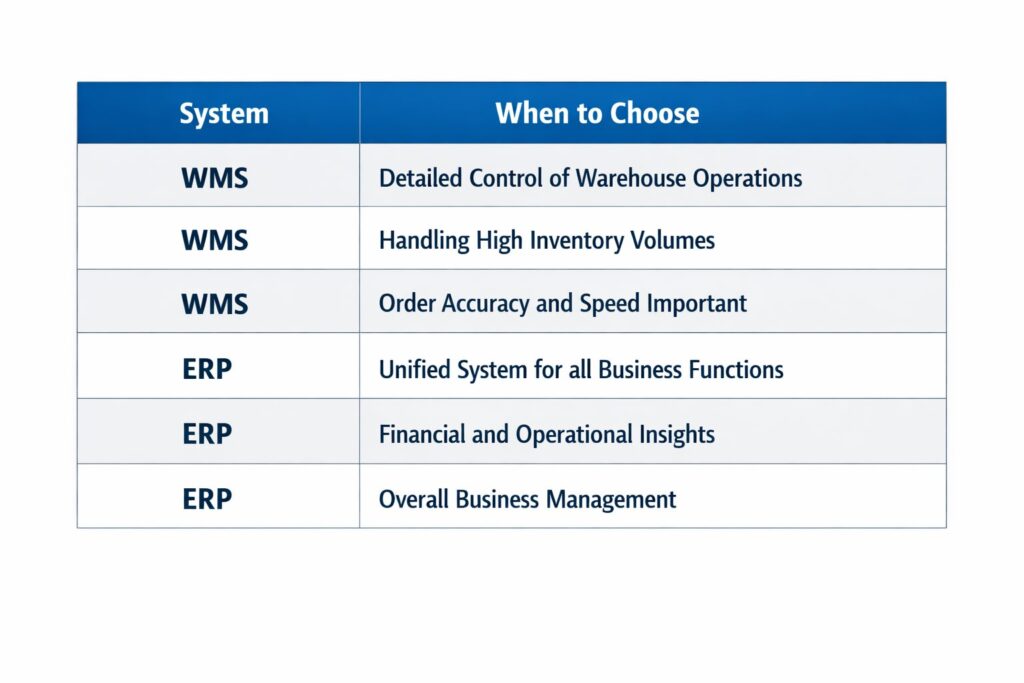
By integrating WMS and ERP, most businesses avail many benefits. This combination ensures operational efficiency at the warehouse level while maintaining strategic control across the organization.
Understanding ERP v/s WMS Logistics Comparison is important for building efficient and scalable logistics operations. Optimize your logistics operations and eliminate inefficiencies by investing in the right technology.
Integrate WMS or ERP or both to build a smarter, faster and more profitable supply chain for tomorrow.
FAQs
- How does a warehouse management system work?
A warehouse management system works by tracking, organizing and optimizing inventory movement in real time. 3PL Anywhere offers customized WMS solutions, ensuring accuracy and efficiency. - Can WMS replace ERP?
No, ERP cannot fully replace WMS. While ERP handles broader business processes, it lacks the detailed functionality required for efficient warehouse management. - Can WMS and ERP work together?
Yes, integrating WMS with ERP blends operational efficiency with strategic management. Contact 3PL Anywhere to manage your inventory effectively in a cost-effective way.
About the Author
3PL Anywhere is a trusted third-party logistics provider offering tailored fulfillment services. We are committed to delivering quality logistics and distribution services aligned with your requirements.
With the WMS system in the warehouse, 3PL Anywhere ensures businesses have real-time visibility, automation and seamless integrations to streamline logistics operations.
The brand manages warehousing, inventory and order fulfillment on behalf of businesses.